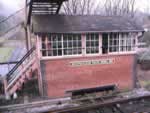
Buckfastleigh South Signal Box
| |
 |
I don't really think my volunteer work on the South Devon Railway
as a Signalman could really be classed as a career, but I think
this is the best section for it. I try to do as much work on the
line as much as possible as I find it much more interesting being
a Signalman. However, I do need some free time so I can usually
only manage a couple of days per month. I'm also one that likes
to be busy and under pressure. Therefore, I try to work as many
special event days as possible whilst not trying to appear like
I'm hogging them!
Training
I only really "trained" as such for about a month. I
already knew the 1973 rule book and the principle of single line
working with token or staff through my interest in signalling. So
all I really had to do was brush up on the rules and gain experience
of the frame. I passed out a couple of days after my 18th birthday.
Making me the youngest Signalman on the South Devon Railway and
at the time (and possibly still) the youngest Signalman in the UK.
Job Benefits
The main benefit is that I get to work as a Signalman! On a quiet
day there is very little to be done and in between trains I usually
find myself tidying an area of the box that no one seems to have
touched for years.
Can't be bothered to write much more today, kettle's boiling! |

| Photographs
of Buckfastleigh South - Click to Enlarge |
|
|
|
|
 |
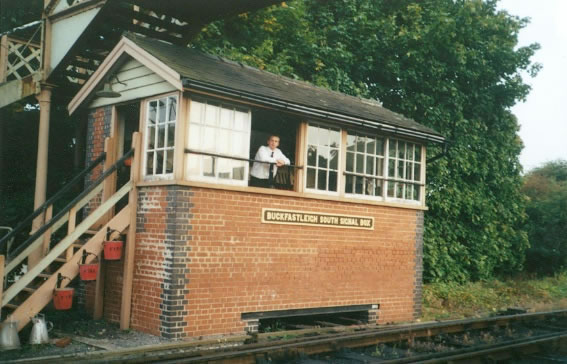
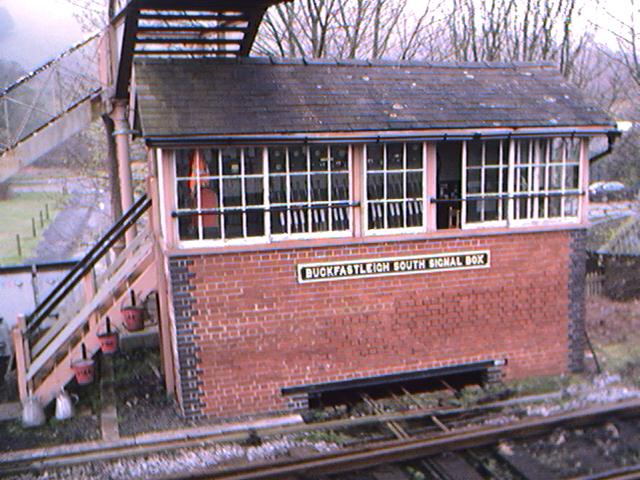
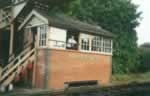
| General portrait of the Signal
Box, taken from the end of Buckfastleigh platform. Also showing
me dangling out! |
|
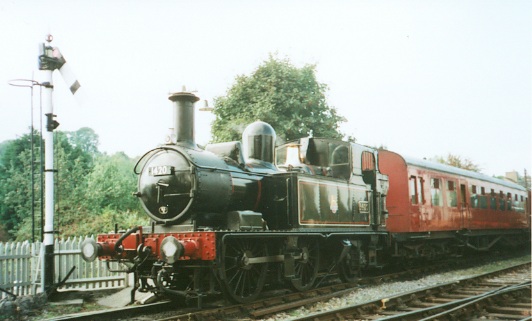
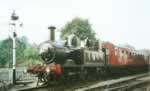
Picture taken at the bottom
of the Signal Box steps, showing an auto train standing at No.
2 Signal - Platform Starting to Up Main - in the "off"
position. |
 |
|
 |
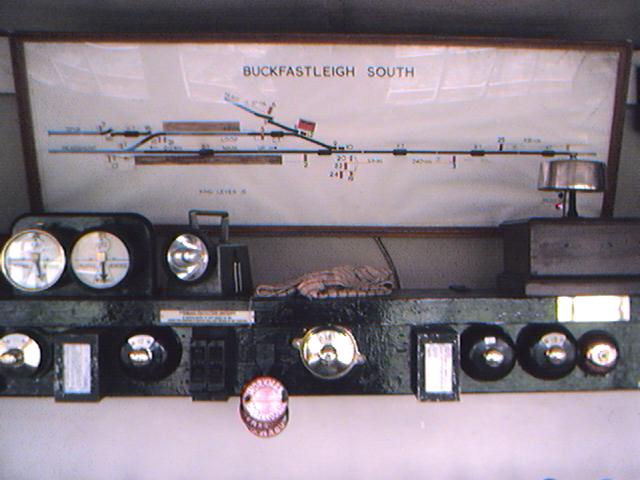
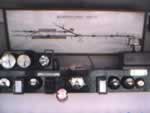
| That is the Signal
Diagram, showing the signals and their numbers. Information
on Points and FPL's also locations of telephones and important
features. The picture also shows a bit of the Block Shelf with
plungers, sealed releases, repeaters, bell from Bishops Bridge
Signal Box, as well as a trusty Bardic lamp and duster. |
|
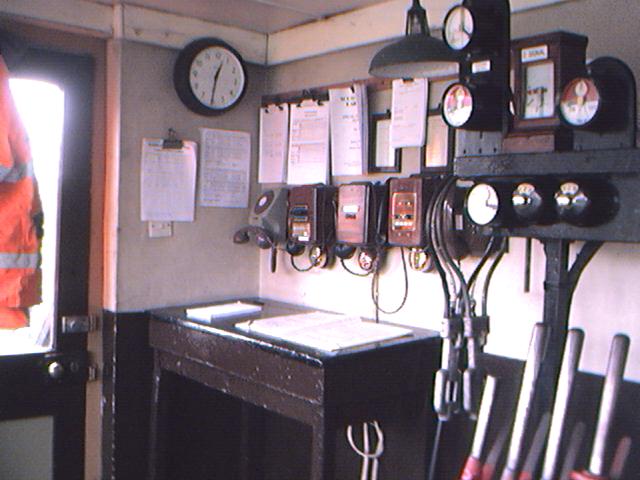
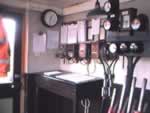
The Booking Desk,
information is written in the Train Register here. There is
also the clock, Signal Post Telephones, Box to Box Phone, and
the Omnibus Circuit. A high visibility jacket rests on the coat
hook. The hoops on the right are used to put the "token"
in to give to the driver. The driver won't enter the single
line section without the token and only one token can be out
of the instrument at any one time. Note "God" is standing
on the other side of the door... |
 |
|
 |
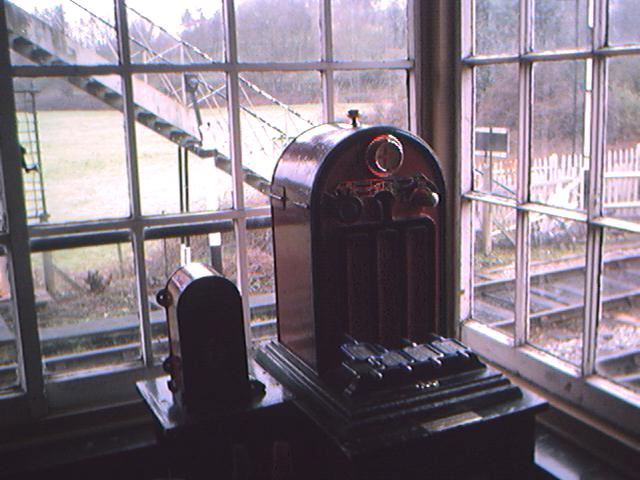
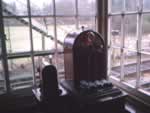
| This is the Electric
Key Token Instrument. Only one token can be removed at any one
time, and only with the permission of the Signalman at the other
Signal Box. The smaller instrument is the Annetts Key Release,
only used when the "Long Section Staff" is in use. |
|
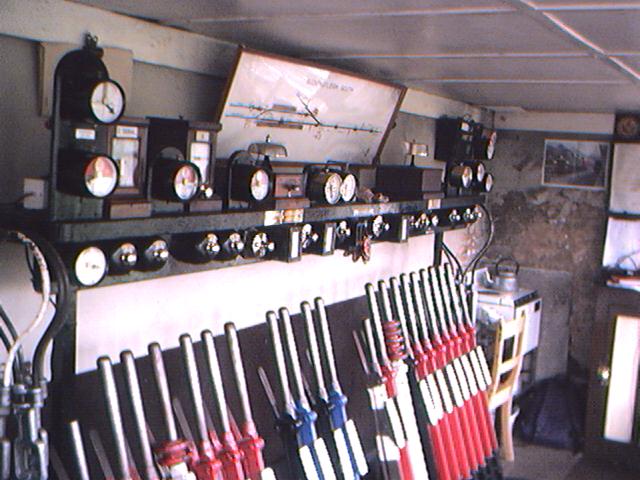
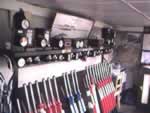
A general view of
the lever frame, red levers for signals, black for points and
blue for facing point locks. White are spare and I can't be
bothered to explain the purpose of the brown and white striped
one! There used to be a nice coal stove in the corner, recently
replaced with an electric oven! |
 |
|
 |
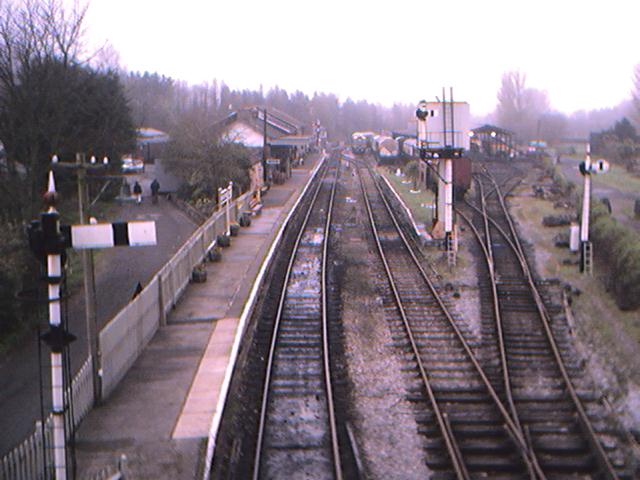
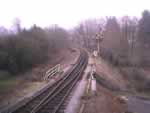
| Looking up the line
(up being towards London). Here is the main gantry, controlling
movements in the down direction. The tall signal with the longest
arm is No.24 "Down Main Inner Home," the is a little
arm beneath this. That is a calling on signal No.19. No.22 "Down
Main Inner Home to Loop" is to the left of that, and beyond
that is No.20 "Down Main Inner Home to Yard," it's
actually an elevated disc. |
|
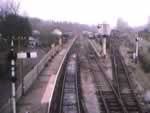
Rotating 180°
we're now looking in the Down direction. The signal on the left
is No.2 "Platform Starting to Up Main." That in front
of the water tower is No.5 "Loop Starting to Up Main."
The signal on the right is the exit from the yard. I'm guessing
you're fed up with signal numbers and descriptions! |
 |
|
|
| No prizes for guessing
what this is! |
|
|
|