

Somerset & Dorset Railway Heritage Trust
Hand Signals
| R50 | Hand Signals | ||
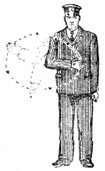
| R50.1 | A red hand signal indicates Danger and, except as shown below, must only be used when it is necessary to stop a train. In the absence of a red light, any light waved violently denotes Danger. | ||
| Exception | |||
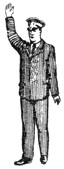
| To indicate to a Driver that the vacuum re-quires to be created. (General regulations for working the Vacuum Brake. | Red light moved vertically up and down above shoulder level. | ||
A yellow hand signal indicates Caution and is to be used for the following purposes :- |
|||
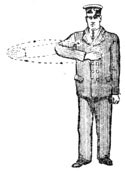
| 1. To indicate to Driver and Guard during fog or falling snow that a distant signal is a Caution or that a warning signal has been taken off. - Rule 59, 91 and 194 | Yellow hand signal held steadily by Fogsignalman. | ||
| 2. To indicate to Driver that a distant signal is defective and cannot be placed at Caution. - Rule 81. | Yellow hand signal held steadily by Handsignalman at distant signal. | ||
| 3. To indicate to Driver that single like working is in operation. - Rule 200. | Yellow hand signal held steadily by Handsignalman at a distant signal. Applicable to the line upon which single line working is in operation. | ||
| The purposes for which a white hand signal is used are as follows :- | |||
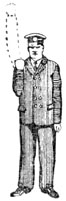
| 1. Move away from hand signal, in shunting. - Rule 52 | White light waved slowly up and down. | ||

Notes
Uses instructions from:
- BR.29960 Regulations For Train Signalling (non Western)
- GE/RT8000/TS8 One-train working regulations